
Understand Why Measurement Location Matters
The two most common at-home blood pressure monitors measure at different points on your body, and that difference affects accuracy, comfort, and fit.
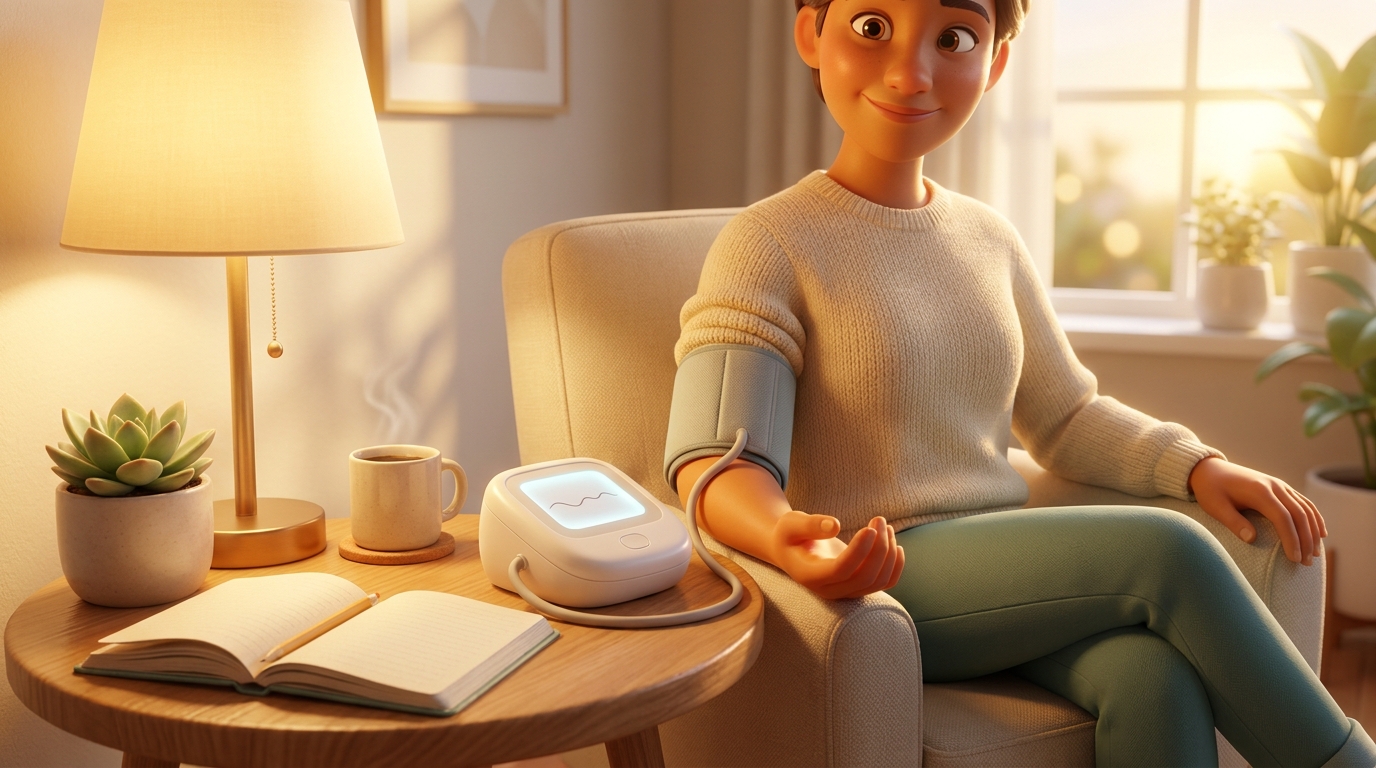
Upper-arm monitors wrap a cuff around your upper arm, just above the elbow. They measure at the brachial artery, which is the same site clinicians use in a medical office. This makes upper-arm readings easier to compare to your doctor's baseline measurements. Most clinical validation studies are conducted on upper-arm devices, so there is more published evidence supporting their accuracy across a wide range of patients.
Wrist monitors are smaller, lighter, and easier to travel with. They measure at the radial artery. The limitation: wrist position is highly sensitive. Even a slight tilt of the hand can shift a reading by a meaningful margin. To get a reliable result, you must hold your wrist at heart level every single time. Some people manage this consistently; many do not.
For most home users, particularly those managing hypertension under a doctor's guidance, an upper-arm monitor is the more reliable starting point. Wrist monitors are reasonable for people with very large arms that are difficult to cuff, or for those who travel frequently and understand the positioning requirements.
Get Your Cuff Size Right Before You Buy
Cuff size is the single most overlooked factor in home blood pressure monitoring, and an ill-fitting cuff produces inaccurate readings regardless of how good the device is.
To size your cuff, measure the circumference of your upper arm at the midpoint between your shoulder and elbow. Use a flexible measuring tape and record the number in centimeters.
Common cuff size ranges:
- Small adult: approximately 22 to 26 cm
- Standard adult: approximately 27 to 34 cm
- Large adult: approximately 35 to 44 cm
- Extra-large (thigh-size): approximately 45 to 52 cm
A cuff that is too small will produce falsely elevated readings. A cuff that is too large tends to produce falsely low readings. Most monitors sold for home use include a standard adult cuff and indicate on the packaging which arm circumference range it fits. If your measurement is near a boundary, size up rather than down.
Some monitors are sold as a unit with one cuff. Others allow you to purchase the cuff and monitor separately, which is useful if you are between sizes or if multiple household members with different arm sizes share the device.
Choose Between Automatic and Manual Inflation
Nearly all monitors marketed for home use today are fully automatic: you press one button, the cuff inflates and deflates on its own, and the reading appears on a digital screen. These are appropriate for the vast majority of home users.
Aneroid (manual) monitors use a dial gauge and a squeeze bulb to inflate the cuff. You listen through a stethoscope and record the reading yourself. These require training to use accurately and are primarily used by clinical professionals or caregivers who have received instruction. If you have not been trained in auscultatory technique, an automatic device is the right choice.
Within the automatic category, look for devices that:
- Take and average multiple readings automatically in a single session
- Have a clearly readable display (large digits, backlit if needed)
- Store at least 30 readings in memory so you can show your doctor a log
- Indicate an irregular heartbeat, which some devices do flag as a warning to consult a clinician
Decode Validation Standards and What They Mean
A monitor being sold legally does not automatically mean it has been independently validated for accuracy. Validation is an additional step where the device is tested in a structured clinical study against a reference standard.
Look for monitors that have been validated according to one of these recognized protocols:
- AAMI/ISO 81060-2: The standard most commonly used in the United States, overseen in part by the American National Standards Institute
- British Hypertension Society (BHS) protocol: Common in devices validated for European markets
- European Society of Hypertension (ESH) protocol: Another widely accepted international standard
The American Heart Association recommends using monitors that have been validated, and the Validate BP database (validatebp.org) maintains a publicly searchable list of devices that have passed clinical validation studies. This is one of the most practical resources you can use before purchasing.
FDA clearance (often labeled as 510(k) cleared) means the device has been reviewed for safety and substantial equivalence to a predicate device. It is a regulatory requirement, not a substitute for independent clinical validation. Both clearance and validation together represent the stronger standard.
Decide Whether Bluetooth Connectivity Is Worth It
Bluetooth-enabled monitors sync readings to a smartphone app, which can automatically log dates, times, and trends over weeks or months. For people who have been asked to track their blood pressure consistently, this can genuinely reduce the friction of keeping a manual log.
Practical considerations before buying a connected monitor:
- App stability matters. An app that stops being supported by the manufacturer renders the connectivity feature useless. Check when the app was last updated and whether it is compatible with your current phone operating system.
- Data sharing. Some apps allow you to export a PDF or CSV file to share with your doctor. Confirm this feature exists before purchasing if data sharing is a priority.
- Battery use. Bluetooth monitors typically require more frequent battery replacement or recharging. Confirm what power source the device uses.
- Privacy. Health data synced to a third-party app is subject to that company's privacy policy, not HIPAA in most cases. Read the policy if this is a concern.
A non-connected monitor with a good memory function and a manual log works perfectly well for most users. Bluetooth is a convenience feature, not a clinical requirement.
Use Your Monitor Correctly for Meaningful Results
Even a clinically validated monitor produces unreliable data if used incorrectly. The American Heart Association and most device manufacturers recommend the following:
- Sit quietly for five minutes before measuring. Avoid caffeine, exercise, and smoking for at least 30 minutes prior.
- Sit with your back supported, feet flat on the floor, and legs uncrossed.
- Rest your arm on a flat surface so the cuff is at heart level.
- Take two to three readings, one minute apart, and record all of them.
- Measure at the same time each day for consistency, typically morning and evening.
A single reading is rarely sufficient for clinical decisions. Patterns over days and weeks are what your doctor uses to assess your blood pressure status.
Know When a Home Monitor Is Not Enough
Home blood pressure monitoring is a useful tool for tracking trends, but it does not replace professional evaluation. Bring your monitor to a clinic appointment so your doctor can compare your home device to a calibrated clinical device. If the readings differ significantly, there may be a cuff fit, positioning, or device accuracy issue to address.
Contact a clinician promptly if:
- You record consistently elevated readings on multiple occasions, or a reading that is severely elevated at any point
- You experience symptoms such as severe headache, chest pain, or shortness of breath alongside an elevated reading
- Your readings vary dramatically from one session to the next without a clear reason
A home monitor supports your care. It does not replace it.
At a Glance: Key Buying Checklist
- Upper-arm monitors are more reliable for most users; wrist monitors require strict positioning discipline
- Measure your arm circumference before buying; cuff fit directly affects accuracy
- Choose fully automatic unless you have clinical training in manual technique
- Check the Validate BP database (validatebp.org) to confirm clinical validation
- FDA 510(k) clearance is required by law but is not the same as independent validation
- Bluetooth is optional: useful for automatic logging, not required for accuracy
- Follow the prep steps every time: five minutes of rest, correct posture, arm at heart level
- Bring your monitor to your next appointment to calibrate it against your clinician's reading
This article is for informational purposes only and is not medical advice. Always consult a qualified healthcare provider for personal medical questions, diagnosis, or treatment decisions. Product fit and use depend on individual circumstances.